
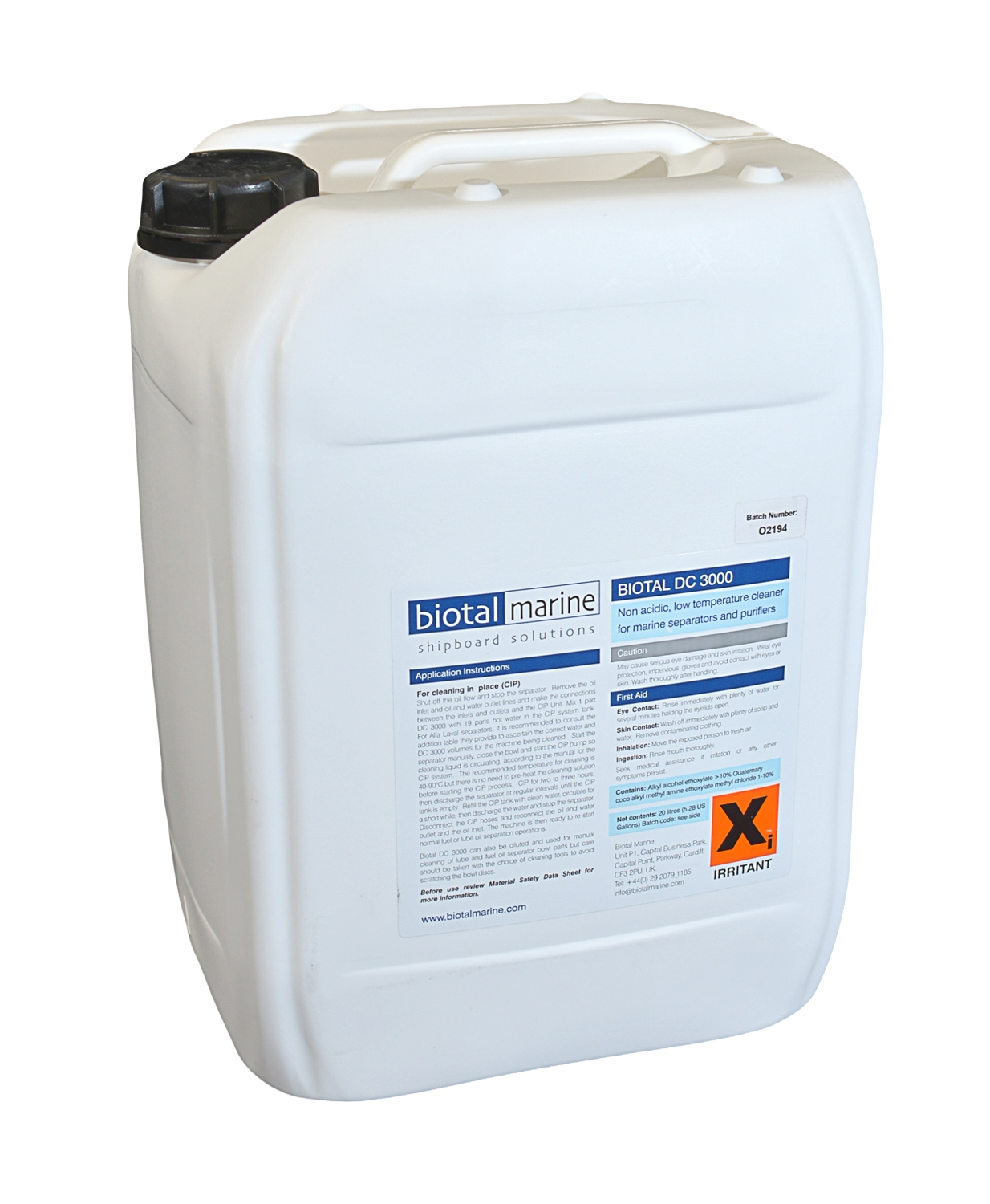
Applications > ENGINE ROOM > Biotal Marine DC 3000Biotal DC 3000
20 LITRE JERRY CANS — OTHER SIZES AVAILABLE ON REQUEST — LIQUID FORMAT
This highly concentrated, non-acidic cleaner is developed for cleaning in place (CIP) and manual cleaning of marine lube and fuel oil separators (purifiers). It removes heavy disc stack deposits without etching separator components and is effective even at low operating temperatures.
Application: Marine lube and fuel oil separators (purifiers), incl. disc stacks & associated bowl components
Use: CIP cleaning via separator system connections, or manual cleaning of dismantled separator parts
Use type: Periodic in-service maintenance or overhaul cleaning
Product specification
Application area
Marine lube and fuel oil separators, including disc stacks, bowls and associated pipework
Purpose
Removal of varnish-like deposits and accumulated soiling to maintain peak separation efficiency without aggressive acidic chemistry
Targets
Oil residues, sludge deposits and hardened disc stack contamination within lube and fuel oil separators
Format
Highly concentrated, non-acidic liquid cleaner formulated for CIP and manual cleaning
Packaging
20 litre jerry cans as standard. Other pack sizes available on request
Dosing
Standard dilution: 1:19 with hot water in CIP systems.
Typical cleaning temperature range: 40–90°C.
Circulate for 2–3 hours before discharge and rinse with clean water.
Overview
Biotal DC 3000 is a concentrated, eco-benign® separator cleaner designed for safe and effective cleaning of marine lube and fuel oil purifiers.
Unlike acidic separator cleaners, it does not etch disc surfaces, helping to reduce wear and minimise rapid re-soiling between cleaning cycles.
The formulation is highly effective at lifting varnish-like deposits while remaining quick-breaking, meaning removed oil separates from the cleaning solution once discharged. This minimises emulsification risks and helps protect onboard oily water separation systems.
DC 3000 delivers >99% soil removal at temperatures as low as 40°C, eliminating the need for excessive pre-heating and reducing cleaning time, energy demand and crew input.
Benefits
Maintains peak separation efficiency and protects engine assets
Removes heavy separator deposits without acidic etching
Effective at low temperatures, reducing heating requirements
Minimises emulsification and protects oily water separator performance
Highly concentrated formula reduces onboard storage requirements

More about this product
Looking for more info? Get in touch with our helpful team for data sheets or product enquiries.
ALL REGIONSLow foaming, low odour and easy to use
Find a distributor
-
Genesis Biosciences (UK)
Areas covered: All UK and Europe, Middle East and Africa
Based: Cardiff, UK
-
Genesis Biosciences (US)
Areas covered: Southern USA 🇺🇸 North West USA 🇺🇸 Canada 🇨🇦
Based: Lawrenceville, GA, USA
-
A.G. White Technical Services Inc.
Areas covered: North West USA 🇺🇸 Canada 🇨🇦
Based: Nova Scotia, Canada
+1 (902) 468-2962
info@agwhitegroup.com -
DistributionNOW
Areas covered: Southern USA 🇺🇸
Based: Houston, TX, USA
+1 (281) 823-4700
customerservice@dnow.com -
The Buying Network
Areas covered: North West USA 🇺🇸
Based: Seattle, WA, USA
+1 206-764-5560
procurement@thebuyingnetwork.com -
Baltrader
Areas covered: Estonia 🇪🇪 Latvia 🇱🇻 Finland 🇫🇮
Sweden 🇸🇪 Germany 🇩🇪 Poland 🇵🇱 UAE 🇦🇪Based: Estonia, Europe
+372 5810 9727
info@baltradermarine.com -
JOWA (Netherlands)
Area covered: Netherlands 🇳🇱
Based: Holland, Europe
+31-180 55 71 33
sales@jowa.com -
JOWA (Norway)
Area covered: Norway 🇳🇴
Based: Norway, Europe
+47-3223 6700
sales@jowa.com


Our products are designed for environmental responsibility
Eco-benign® formulations
Designed to perform effectively while breaking down to natural biomaterials that are biodegradable in treatment systems and the environment.
Reduced reliance on aggressive chemistry
Replaces or reduces the need for corrosive mineral acids, solvents and caustic treatments traditionally used on board.
Lower environmental impact by design
Formulated to avoid the environmental hazard classifications associated with traditional acids and heavy chemistry.
Gentler on marine environments
Focuses on biodegradation and controlled breakdown of waste, rather than simply lowering oil levels without regard for wider toxicity